
Blog

QR Code vs Barcode Asset Tags: Which to Specify

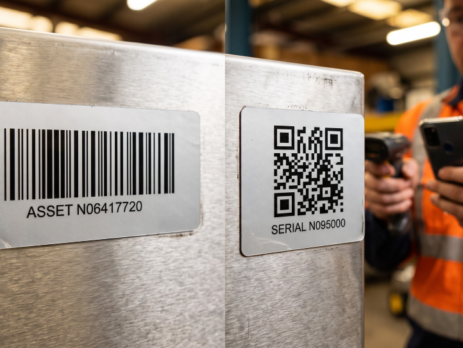
Choosing QR code vs barcode asset tags comes down to one question: does the person scanning the tag need more than a number? A 1D barcode holds a short identifier, reads quickly on a dedicated scanner, and is all a fixed asset register needs when every scan happens inside the inventory system. A QR code holds a longer string, including...

Polyester Asset Labels: Why the Material Matters

Polyester asset labels are the default material for an asset register that has to stay readable for the life of the equipment. Paper is fine for a shipping carton and standard vinyl for a short-term marking; neither is meant to be scanned repeatedly on equipment that gets wiped down, moved, heated or handled for years. Polyester holds its print and...

Laminated Asset Tags

Green tags for one department, red for another, blue for a third: color-coded laminated asset tags let anyone walking a floor see which group owns a piece of equipment without scanning it, while the barcode and number underneath carry the record. The laminate is the part that keeps the scheme working for years. A clear layer over the print protects...

Government Asset Labels

Government Asset Labels | How to Specify for Public Sector Government asset labels have to do something office labels do not: prove, years later and to someone who was not there, that a given item is the item the register says it is. Specifying them means deciding three things — whether the tag must show evidence of tampering, what finish survives...

QR Barcode Labels: How to Specify Custom QR Asset Tags

QR barcode labels put a scannable, phone-readable identifier on every item in an asset register, which is why they have largely replaced linear barcodes on new asset-tagging projects. Specifying a custom run means settling four things: what the code encodes, how big the code has to be to read reliably, what face stock it prints on, and how the codes...

Industrial Asset Tags

  Industrial asset tags are durable identification labels applied to plant, machinery, tooling and fleet vehicles so that each item carries a fixed, scannable identity. Specifying one comes down to four decisions: the surface it has to bond to, whether the tag should come off cleanly or not at all, what finish your scanner can actually read, and how the numbering...

PolyAsset, PolyVoid, PolyCheck

A Visual Guide to PolyLabel's Security Label Family If you've been referred to PolyLabel or seen the product names and need to get your bearings, this guide lays out the whole family in one place. There are six core products across two families — one built for plain durability, one built to show tampering — all in the $135–$495 range, all...