


Grant Funded Equipment: Asset Tags and Federal Property Records
Grant funded equipment has to be traceable from purchase to disposal, and the federal property rule at 2 CFR 200.313(d) sets out what that takes. It calls for property records that include “a serial number or another identification number”, a physical inventory reconciled with those records at least once every two years, a control system against loss, damage or theft, and regular maintenance. The rule asks for records. It does not require a physical tag. A tag is the practical way to put the record’s identification number on the item itself, so the inventory becomes a scan and a missing item can be traced.
What the federal property rule asks for
The requirement in 2 CFR 200.313(d) has four parts.
-
- Records. “Property records must include a description of the property, a serial number or another identification number, the source of funding for the property (including the FAIN), the title holder, the acquisition date, the cost of the property, the percentage of the Federal agency contribution towards the original purchase, the location, use and condition of the property, and any disposition data including the date of disposal and sale price of the property.”
-
- Inventory. “A physical inventory of the property must be conducted, and the results must be reconciled with the property records at least once every two years.”
-
- Control. “A control system must be in place to ensure safeguards for preventing property loss, damage, or theft. Any loss, damage, or theft of equipment must be investigated.”
-
- Maintenance. “Regular maintenance procedures must be in place to ensure the property is in proper working condition.”
Equipment has a defined meaning here. Under 2 CFR 200.1, it is tangible personal property with a useful life of more than one year and a per-unit acquisition cost at or above the lesser of the organization’s capitalization level or $10,000. Check that definition against your own capitalization level before deciding what to tag; items below the line may still be worth tagging under your own policy.
Nothing in that text mentions labels. A tag is how the record and the item are connected in practice, and the rest of this article covers what that takes.
What goes on the tag and what stays in the register
Most of the record does not belong on the item. The tag carries the key, and the register carries everything else.
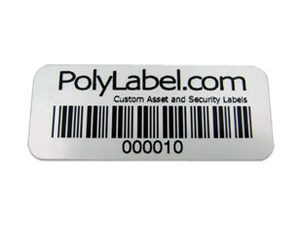
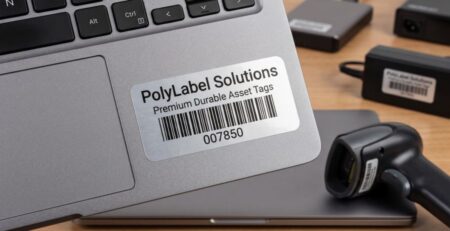
On the tag: the identification number, printed as a barcode and as human-readable characters, and usually the organization’s name. That is enough to scan the item, read it when a scan fails, and find the record.
In the register: the description, the manufacturer’s serial number, the source of funding and the FAIN, the title holder, the acquisition date, the cost, the percentage of federal contribution to the purchase, the location, use and condition, and, later, the disposition data.
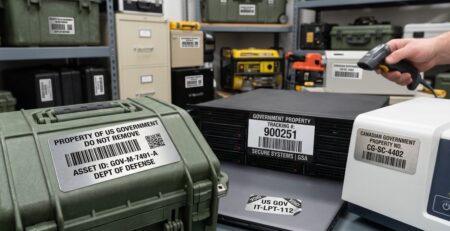
Keep the FAIN and the cost off the tag. Neither is needed to identify the item, both put award and financial details on display wherever the equipment sits, and a correction to the record would mean replacing the tag. The government asset labels article covers numbering schemes that hold up when equipment moves between departments, which applies just as much to a grant register.
Use the tag number as the identification number
The rule asks for “a serial number or another identification number”. A manufacturer’s serial number is one option, but serials come in different formats, sit in different places, and are missing altogether on some fabricated or assembled items. A tag number assigned at receiving gives every item an identification number in one format, printed where it can be found.
Record both. The serial number stays in the register for warranty and service, and the tag number becomes the key that the inventory, the maintenance log and the disposal record all use. The IT asset tags article explains why the asset number and the serial number do different jobs.
Tag at receiving, before the equipment is deployed. An item that goes into service untagged is the one that turns up at the next inventory as an unknown.
Color-code by funding source or program
Laminated tags come in green, red and blue, with a clear laminate that protects the barcode and print. Color gives the inventory team a split the register cannot show on the floor: which items were bought with federal award funds, without opening a record.
Pick one rule and hold to it. One workable scheme uses green for equipment bought under federal awards, blue for other grant funding and red for equipment bought with the organization’s own funds. Another assigns a color to each program. Either way, the register still holds the specific award and its FAIN; the color only answers the first question.
Specify human-readable numbers above or below the barcode, so the number can be keyed when a scan fails. The laminated asset tags article covers how to assign color meaning before the first order.
Make the biennial inventory a scan, not a hunt
The physical inventory has to be reconciled with the property records at least once every two years. With a barcode on every item, the inventory becomes a walk with a scanner: each scan confirms that the item exists, where it is, and that its tag matches its record. Without tags, each item is matched to its record by description and serial number.
Plan the walk by building and room, using the register’s location field, and record everything found, not only what is on the list. The result is three exception lists: on the record but not found, found but not on the record, and found in the wrong place. The year-end asset inventory article covers how to resolve each one. Where barcodes are scanned routinely and color is not needed, PolyAsset White, a white semi-gloss polyester, is the finish to specify.
Tamper-evident tags where theft is the risk
Paragraph (d)(3) calls for safeguards against loss, damage or theft, and for any loss, damage or theft of equipment to be investigated. A tag that can be peeled off one item and stuck on another undermines both: a substituted item passes the inventory, and the investigation has nothing to go on.
For portable, high-value equipment, specify a tamper-evident construction.
PolyVoid. PolyVoid White is a white polyester label. When it is lifted, VOID appears on both the surface and the label, so the evidence stays on the equipment.
PolyBreak. A destructible white semi-gloss polyester with a very aggressive solvent-based adhesive. It fragments on removal and cannot be moved to another asset.
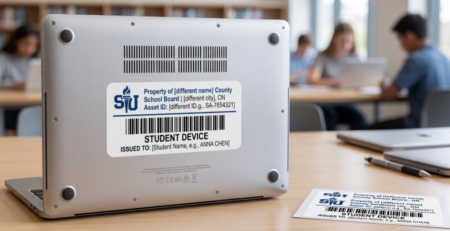
Both can carry sequential barcode numbering, so the tamper-evident tag is also the identification tag. Keep them for laptops, cameras, instruments and tools that leave the building; fixed furniture rarely needs them. The government asset labels article covers how to match tamper evidence to disposal risk.
Tie maintenance records to the tag number
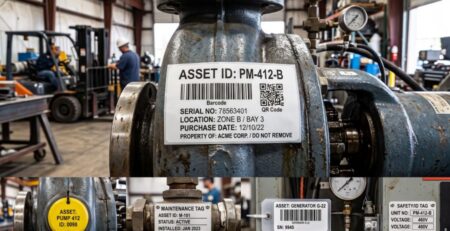
Paragraph (d)(4) asks for regular maintenance procedures that keep the property in proper working condition. The tag number is the simplest key for those records: every service, inspection and repair is logged against it, and the history follows the item when it moves. For how that history holds up when someone asks to see it, read about a PM history log as a compliance trail.
Close the record at disposition
When equipment is sold or scrapped, the record needs its disposition data, including the date of disposal and the sale price. Write the tag number on the disposal paperwork so the paperwork and the record match, then mark the record as disposed and retire the number. Never reissue a tag number to a new item, because a reused number joins two histories in one record.
Check your award terms and agency guidance
The text quoted here is the general federal rule as published in the eCFR. Some awarding agencies and states add requirements, and your award terms may say more about records, inventory or marking. Check your award terms and your agency’s guidance before you settle the record fields and the tagging scheme. This article explains how tags support the records the rule describes; it isn’t legal advice.
Specifying tags for grant funded equipment
Tags for grant funded equipment carry the identification number and barcode that tie each item to its property record, while the FAIN, cost and funding details stay in the register. Add color by funding source and tamper evidence where theft is a risk.
Tell us how many items you are tagging, how many funding sources or programs need their own color, which items need tamper evidence, and the numbering range to continue, and we will quote the right construction. Request a quote, or request samples to test the tags on your own equipment before the next inventory.







Leave a Reply
You must be logged in to post a comment.