

Government Asset Labels
Government Asset Labels | How to Specify for Public Sector
Government asset labels have to do something office labels do not: prove, years later and to someone who was not there, that a given item is the item the register says it is. Specifying them means deciding three things — whether the tag must show evidence of tampering, what finish survives the environment while staying scannable, and how numbering holds up when assets move between departments. Public-sector asset registers outlive the staff who build them, which is why the tagging decision is harder here than in a private office.
The reason it matters is disposal. A municipality or agency retiring equipment has to show the asset it wrote off is the asset that left the building, and a tag that can be lifted and moved breaks that chain quietly.
What public-sector tagging has to account for
Four conditions shape the specification, and they rarely all apply in a private-sector fixed-asset programme.
Assets move between departments. A laptop issued to one office is redeployed to another; a generator moves between facilities. Government asset labels have to remain readable and, more importantly, have to remain attached to the same physical item rather than following the paperwork.
The register outlives its authors. Public-sector asset registers commonly run for a decade or more across multiple staff turnovers. A numbering scheme that made sense to the person who invented it is worthless if nobody left can explain it.
Audit is periodic and physical. Someone walks the building with a scanner and reconciles what is present against what is recorded. Everything about tag placement, size and legibility should be decided with that walk in mind, because it is the moment the tagging programme either works or does not.
Disposal has to be provable. Surplus, auction and write-off all require showing that a specific asset was disposed of. That is where tamper evidence stops being a nice-to-have.
Decide whether the tag needs to show tampering
This is the first real fork in specifying government asset labels, and it splits the product decision cleanly.
A standard asset label is designed to stay attached and stay readable. It can be removed with effort, and it comes off largely intact. For most furniture, fixtures and low-value equipment, that is the right specification and the cheaper one.
A tamper-evident label is designed so that removal is visible afterward. Two constructions do this differently:
PolyBreak uses an aggressive solvent-based adhesive with a destructible face stock. The tag fractures rather than lifting away, so it cannot be peeled off one asset and applied to another in one piece.
PolyVoid leaves a VOID pattern on both the equipment and the label itself when lifted. Tampering is visible from either side — on the item where the tag used to be, and on the tag if it turns up elsewhere.
The distinction matters at audit. A fractured tag tells you a label was destroyed; a VOID pattern tells you where it was destroyed and leaves the evidence on the asset. If your disposal process requires demonstrating that a tag was not transferred between items, the void-return construction is the stronger specification. The tamper evident asset labels guide covers how the constructions differ in more depth.
Apply tamper evidence selectively. Tagging every desk chair with a destructible label is expensive and buys nothing. Reserve it for portable, high-value or politically sensitive items — IT equipment, tools, audio-visual gear, anything that leaves the building.
Choosing a finish for government asset labels
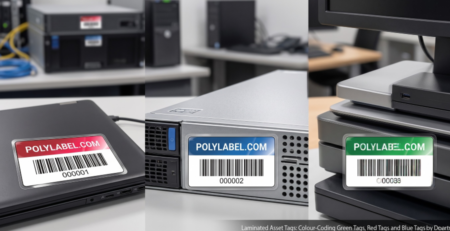
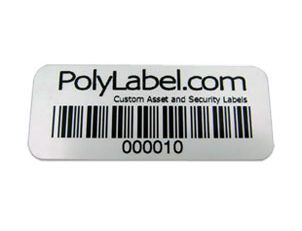
Government asset labels are almost always barcoded, because the audit walk depends on scanning rather than transcribing. That makes the face finish a functional decision.
Reflective and mirror faces interfere with barcode readers. PolyCheck Chrome is the clear example — it is not a barcode-safe choice, and specifying it for a scanned register creates read failures that show up as reconciliation gaps months later. It is chosen for its appearance, not for scanning.
Matte and semi-gloss faces are the safer default. PolyAsset White is a white semi-gloss polyester and gives a barcode the contrast it needs. PolyCheck Platinum and PolyAsset Platinum use metallic aluminum-look polyester where the asset warrants a more substantial appearance — worth sample-testing against your own scanners and your own building lighting before a department-wide order, because how a metallic face reads in a lit corridor differs from how it reads in a plant room.
If your audit staff scan with phones rather than issued readers, weight this more heavily. Phone cameras handle glare less forgivingly than dedicated scanners.
Numbering that survives staff turnover
The numbering scheme is the part of the programme most likely to be regretted, because changing it later means two incompatible tag populations coexisting in one register.
Decide whether the identifier encodes anything. A purely sequential number is simple and permanent, but tells a technician nothing. A scheme encoding department or site is more useful in the field — until an asset transfers between departments and the tag now says something untrue. For public-sector registers, where transfers are routine, a neutral sequential identifier with department held in the register rather than on the label usually ages better.
Settle the human-readable line as well. The barcode serves the scanner; the printed characters serve the person holding a clipboard when a scanner fails. An identifier and the owning organisation is generally enough.
Size the tag against the smallest asset in scope. A format that fits a desktop tower and fails on a handheld radio means running two orders.
Defending the spend
Asset tagging competes for budget against everything else, and it is easy to lose because the benefit is preventative rather than visible. The argument that works is the one finance can evaluate: what the programme costs per asset, against what an unreconciled register costs at audit and disposal.
The structure translates well from other capital planning. This guide on presenting a maintenance budget to finance sets out a per-category format with benchmark comparison and prior-year variance — the same shape a tagging submission needs, and a useful template if you are building the case rather than defending an existing line.
Rolling out across departments
Roll out government asset labels by building or department rather than by asset class. Finishing one facility completely keeps the register and the physical estate reconcilable as you go; tagging all the laptops across six sites leaves every site partially done for weeks.
Fix tag placement per asset type before the first application and photograph it. Consistent placement is the single largest determinant of how long the audit walk takes, and it is decided in the first hour of the rollout.
Order above the asset count. Applications get spoiled, equipment arrives mid-programme, and a small reorder costs more per unit than the original margin.
Institutions running a school estate face a near-identical problem with a different procurement cycle — the school asset labels range covers that case.
Specifying your government asset labels
Match tamper evidence to disposal risk rather than applying it everywhere, pick a face your scanners can read, and settle numbering before the first order rather than after.
Public-sector orders are quote-led, so tell us the asset count, the environments involved, whether tamper evidence is required and for which categories, and any format constraints your register imposes. Request a quote with those details and we will come back with a recommendation and pricing. If you would rather test constructions on your own equipment first, ask for samples alongside the quote.