

Polyester Asset Labels: Why the Material Matters
Polyester asset labels are the default material for an asset register that has to stay readable for the life of the equipment. Paper is fine for a shipping carton and standard vinyl for a short-term marking; neither is meant to be scanned repeatedly on equipment that gets wiped down, moved, heated or handled for years. Polyester holds its print and its shape through moisture, abrasion, temperature swings and cleaning chemicals, which is why it is the material behind PolyAsset White and PolyAsset Platinum. This article is about that material decision: when polyester is the right answer, when a destructible construction is better, which finish to specify for scanning, and how the adhesive should be matched to the surface.
What the label has to survive
An asset label’s job is to be read, by eye or by scanner, every time the register is checked. Anything that makes the label unreadable, or makes it fall off, breaks the register at that asset. The threats are ordinary ones.
Moisture. Condensation in a cold room, humidity in a plant, a spill on a desk. Paper labels absorb it, swell and lift; the print runs.
Abrasion. Equipment is stacked, slid across benches, carried in cases and rubbed against other equipment. Print on an exposed face wears, and the barcode is the first casualty because a scanner needs every bar intact.
Temperature. Equipment that runs hot, sits in an unheated warehouse or moves between the two. Materials that soften, shrink or go brittle with temperature change lose their print or their bond.
Cleaning chemicals. Disinfectant wipes in a clinic, solvent in a workshop, general-purpose cleaner everywhere else. Print that is not chemical-resistant smears; label stock that is not chemical-resistant breaks down.
A material that handles all four without special treatment is what you want on equipment that will be in service for years. That is the case for polyester.
Polyester against paper, vinyl and destructible vinyl
Each of the common asset label materials has a place. The decision is about matching the material to the service life and the environment.
Paper is the lowest-cost face stock and the least durable. It suits a temporary marking, an internal move tag or an asset that will be disposed of within months. It does not suit an asset register.
Standard vinyl is flexible and conforms well to curved surfaces. It is a step up from paper in moisture and handling resistance, but it is a softer material, and the print on it is more exposed to abrasion and chemicals than print on polyester.
Polyester is the durable general-purpose choice. It is dimensionally stable, so it does not stretch or shrink on the equipment, and it holds print through the moisture, abrasion, temperature and chemical exposure described above. For most asset registers, polyester asset labels are the material to specify unless there is a specific reason to choose something else.
Destructible vinyl is chosen for a different reason. It is not selected for durability; it is selected because it fractures rather than peeling off in one piece, which makes it a tamper-evident construction. That is the next decision.
Decide whether the label needs to show tampering
Durability keeps the label on the asset and readable. It does not stop someone deliberately removing it and putting it on a different asset. If the register has to prove that a label was not moved, the material choice shifts from plain polyester to a tamper-evident construction.
PolyLabel offers two behaviours. PolyVoid leaves a VOID pattern on both the asset and the label when it is lifted, so the label and the surface both show that removal was attempted. PolyBreak, a destructible construction, fractures rather than peeling off intact, so the label cannot be reapplied anywhere.
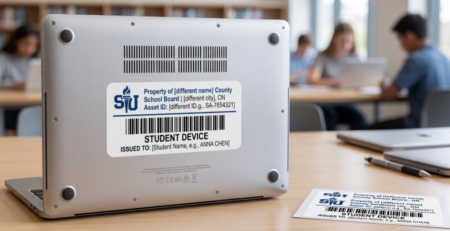
Destructible is the better choice when the priority is that the label can never be transferred: student devices, small high-value items, anything that leaves the site. PolyVoid is the better choice when the priority is a visible record of the attempt on the asset itself. Plain polyester is the better choice when the risk is wear, not tampering, and the register is reconciled by serial number in any case.
The full range of tamper evident asset tags, and how each construction behaves, is covered in that article. The comparison of the PolyAsset, PolyVoid and PolyCheck families as products is in the PolyAsset, PolyVoid and PolyCheck guide; this article stays with the material.
Choose the finish for scanning or for appearance
PolyLabel’s polyester asset labels come in two finishes, and they are for different purposes.
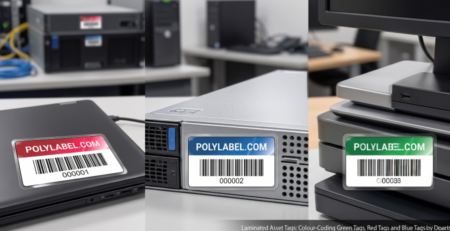
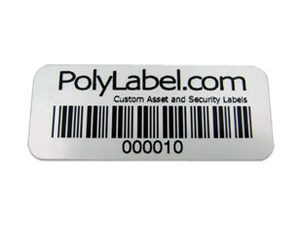
Semi-gloss white is the finish to specify when barcodes are scanned routinely. PolyAsset White is white semi-gloss polyester: a white, low-glare background gives the scanner the contrast it needs to read the bars first time, every time. If the register is scanned, this is the default.
Metallic aluminum-look is for equipment that needs a tag with visual weight. PolyAsset Platinum is metallic polyester with an aluminum-look face, and it is the choice for boardroom equipment, instruments, or any asset where the label is meant to look like part of the equipment rather than an afterthought. If the same equipment is also scanned at audit, specify white for the scanned label and keep platinum for the tag that is meant to be seen.
Reflective faces are a separate matter. A face that mirrors light back at the scanner defeats the contrast the scanner relies on. PolyCheck Chrome, for example, has a reflective face and is not a barcode-safe choice. If a highly reflective finish is wanted for appearance, plan for the barcode to be on a separate label, or accept that the tag is for the eye rather than the scanner.
The rule is simple: if the label will be scanned, semi-gloss white; if it is there to be seen, platinum; and never a reflective face under a barcode.
Match the adhesive to the surface
A polyester face stock is only as good as the bond holding it to the equipment. The adhesive is chosen for the surface, not for the face.
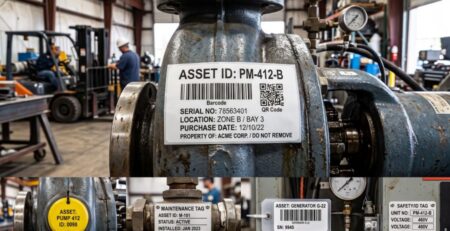
Smooth, high-energy surfaces such as painted metal, glass and hard plastics take an adhesive bond readily. Most asset labels are specified for these, and the standard adhesive is the starting point.
Low-energy plastics, textured or powder-coated surfaces, and curved surfaces are harder to bond to. Some need a more aggressive adhesive; some need a longer dwell time before the bond reaches full strength; some need the label sized so that it sits flat rather than bridging a curve.
Contaminated surfaces defeat any adhesive. Oil, dust, release agents and the residue of the last cleaning product all reduce the bond. Clean and dry the surface before application, and press the whole label down firmly.
Tell us what the equipment is made of, and whether the surface is smooth, textured or curved, and we will advise on whether the label suits it. When in doubt, ask for a sample and test it on the actual equipment before ordering the run.
Specifying your polyester asset labels
Polyester asset labels are the durable default for an asset register, with a destructible construction substituted where the label must never be transferred, a semi-gloss white finish where barcodes are scanned, and an adhesive matched to the surface the label will sit on. If you are still deciding between a tag and a label in the first place, asset tags versus asset labels sets out the difference.
Tell us the equipment, the environment it lives in, whether the labels are scanned, and how many assets are on the register, and we will confirm the material, finish and adhesive. Request a quote, or ask for samples to test the label on your surfaces before you order.