

Tamper Seal Labels: Sealing Cases, Housings and Components
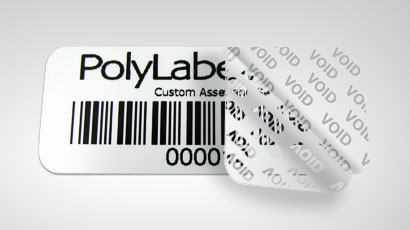
Tamper seal labels close an access point so that opening it leaves evidence. Applied across the seam of a case, over a screw head, or across the edge of a device housing or panel, the seal has to be broken or lifted before the opening can be used, and a broken seal cannot be put back without showing it. That is the whole job: not to stop a determined person, but to make sure that entry, removal or substitution of a component cannot happen unnoticed. Small pre-printed tamper seals in white destructible or chrome checkered-pattern release stock cover most cases; a larger tamper-evident asset label takes over when the seal also has to identify the item.
What a tamper seal is for
A seal protects an opening. It is placed where someone would have to go to get inside: the seam between two halves of a case, the screw that holds a cover on, the door of a cabinet, the flap of a package, the edge of a panel on a meter or a controller. Once applied, anyone opening the access point has to break the seal, and the break stays visible afterward.
That evidence serves three uses.
Deterrence. A visible seal tells the person considering the opening that the attempt will be found. Casual tampering, curiosity and opportunistic theft mostly stop at that point.
Detection. A broken or lifted seal is a fact that can be checked during an inspection, a count or a hand-off. Nobody has to open the case to know it was opened.
Protection against substitution. A seal across a housing shows whether a component inside was swapped, whether a memory module, a drive, a meter board or the contents of a sealed kit. The seal does not identify the part; it shows whether the enclosure stayed closed.
Pre-printed tamper seals are the inexpensive alternative to a custom security label for this purpose. They are made in the smallest practical size, 3/8 × 1 inch, and sold in quantities of 500 to 2,000, which suits an IT bench, a lab, a cash office or a shipping department that seals routinely rather than occasionally.
Seal versus asset tag
The two are often confused because both can be tamper-evident and both go on equipment, but they answer different questions.
An asset tag identifies an item. It carries a number, usually a barcode, and it ties the physical object to a record in a register. It is placed where it can be read, on a flat face that is easy to reach.
A seal protects an opening. It carries no identity of its own: every seal in a batch is printed the same. It is placed across a seam, where reading it is less important than seeing whether it is intact.
A laptop in a corporate fleet may carry both: an asset tag on the lid for the register, and a seal across the bottom-cover seam or over the drive-bay screw to show whether the machine was opened. Public-sector fleets add a further layer, covered in the government asset labels article, where the audit trail expects both the identity and the seal condition to be recorded.
Choose between white destructible and chrome checkered-pattern release
The tamper seals come in two constructions, and the choice depends on what “evidence” needs to look like.
White destructible. The face stock is designed to break apart rather than lift in one piece. An attempt to peel the seal leaves fragments on the surface, and there is no way to remove it cleanly and reapply it. This is the choice where the priority is that the seal cannot be moved or reused: sealing a case that will be shipped, a component that must not be swapped, or a container whose contents are counted at hand-off.
Chrome checkered-pattern release. The chrome face lifts, but leaves a checkered pattern behind on the surface as evidence of removal. The seal itself is spoiled at the same time. This is the choice where the surface should show the attempt clearly even after the seal is gone, and where the chrome face suits the equipment, for example on metal panels and instrument housings where a white seal would look out of place.
Both do the same job. Specify white destructible when the seal must not be transferable; specify chrome when the surface itself should carry the evidence.
Placement across the seam
A seal only works if the opening cannot be used without disturbing it. Placement is where most seal programs succeed or fail.
Bridge the seam. Half the seal on one side of the join, half on the other, so that the two halves cannot separate without the seal tearing or lifting. A seal placed beside a seam, rather than across it, records nothing.
Cover the fastener. For a screw-down cover, place the seal over the screw head that has to turn. One seal per fastener that gives access; the others can be left uncovered.
Choose a clean, flat spot. Textured plastic, dusty metal and oily surfaces reduce adhesion and give a careful person a chance to lift the seal intact. Wipe the area first and press the seal down firmly across its full length.
Keep it visible. The seal should be where an inspector will look without turning the equipment over or opening a door. Evidence nobody sees is not evidence.
At 3/8 × 1 inch, the seal is small enough to sit over a screw head or across a narrow seam without folding over an edge. On a wide seam, use more than one seal rather than a single seal that has to stretch.
Logging seals for audit
Evidence only counts if someone records it. A seal program needs a log that ties each seal to the item it was applied to, the date and the person who applied it, and then a second entry when the seal is checked or found broken.
Record at application. When the seal goes on, note the item, its asset number if it has one, where on the item the seal sits, the date and who applied it. Tamper seals are pre-printed in one standard format and cannot carry serial numbers, which is part of what keeps them inexpensive, so the log identifies each seal by the item and its position. If every seal has to carry its own number, that is a job for a full-size tamper-evident asset label, covered below.
Check at every hand-off. Shipping, receiving, transfer between departments, return from a remote employee, and the annual physical count are all points where the seal’s condition should be recorded as intact or broken.
Investigate breaks, not just note them. A broken seal with no work order behind it is the event the program exists to catch. The log should show who found it, when, and what was done.
Pre-printed seals bought in batches of 500 to 2,000 are easy to keep on hand, so the log can be simple: a column in the asset register or a separate sheet, rather than a separate system. If the register itself needs work, this guide to building an equipment asset registry covers the structure.
When a larger tamper-evident asset label is the better answer
A small seal is right when the job is to close an opening. When the label also has to carry an asset number, a barcode or a company name, or when the surface to be protected is a flat face rather than a seam, one of the full-size tamper evident asset labels does both jobs on one label.
PolyVoid White shows the word VOID on both the label and the surface when it is lifted, so the attempt is visible on the equipment even if the label is reapplied.
PolyBreak White Destructible fragments on removal and cannot be moved to another asset; it is the destructible-seal principle applied to a full asset label with an aggressive adhesive.
PolyCheck Platinum is a two-part metallic label that leaves a checkerboard pattern when removed and can carry a barcode. PolyCheck Chrome gives the same pattern with a mirror finish but is not for barcodes, because the reflective face interferes with scanning.
All of these are polyester constructions. The polyester asset labels article covers why that material is specified for labels that have to stay put and stay legible on equipment. For school and district device programs, the student laptop labels article covers a destructible, laminated property-of label that combines identification and tamper evidence for that use.
Specifying your tamper seal labels
Specify tamper seal labels when an access point has to be closed in a way that shows if it was opened: white destructible where the seal must not be transferable, chrome checkered-pattern release where the surface should show the attempt. Move to a full tamper-evident asset label when the label also has to identify the item.
Tell us how many seals you need, what they will be applied to, and whether an asset label would serve better than a seal, and we will quote the right construction. Request a quote for tamper seals, or request samples to test the seal on your own housings and cases.