

PolyAsset White

PolyAsset White
$135.00 – $495.00Price range: $135.00 through $495.00
White semi-gloss polyester asset labels — the finish to specify when barcodes are scanned routinely and read reliability matters more than appearance.
- Description
- Additional information
Description
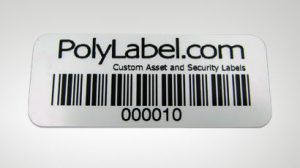
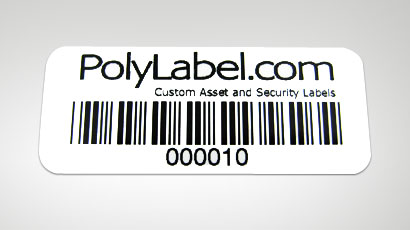
PolyAsset White is an extra durable, non-tamper-evident asset label in white semi-gloss finished polyester mylar. It is the workhorse of the PolyAsset range: the finish most asset registers end up standardising on, because a dark barcode on a white semi-gloss face is what every scanner is designed to read.
Why white is the default for scanned registers
Barcode readers work on contrast. A white semi-gloss face gives the scanner the widest possible difference between the bars and the background, which means faster reads, more tolerance of awkward angles, and fewer failures in poor lighting.
That matters most at audit. Someone walking a building reconciling assets against a register scans hundreds of tags in a session, often in corridors, plant rooms and storage areas where the lighting was not designed with scanning in mind. Every tag that will not read becomes a manual entry, and manual entries are where reconciliation errors come from.
If your technicians scan with phone cameras rather than issued readers, weight this more heavily still. Phone cameras handle glare less forgivingly than dedicated scanners do.
Where PolyAsset White fits
Specify it for IT equipment, office and facilities assets, laboratory and medical equipment, tooling, and any fixed-asset population where the tag is scanned as part of a routine process rather than read by eye. It is also the sensible default for a first tagging programme, where the priority is getting a clean register established before optimising anything else.
Choosing between White and Platinum
White and PolyAsset Platinum are the same construction with different faces. Platinum uses a metallic aluminium-look finish and suits assets where the tag should look like a permanent part of the equipment — machinery, plant, anything a client or inspector sees.
The trade-off is scanning. Metallic faces reflect, and reflection reduces the contrast a barcode reader depends on. If barcodes are central to your programme, White is the safer specification. If appearance matters more and barcodes are secondary, Platinum is the better choice.
Unsure which way to go? Order both as samples and scan them on your own equipment, in the lighting where scanning actually happens.
When you need the tag to resist removal
PolyAsset is a permanent, high-adhesion label, but it is not tamper-evident. It stays attached and stays readable, and it can be removed with effort without destroying itself.
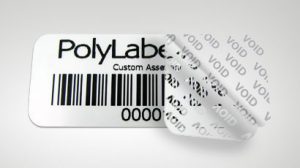
Where the risk is that a tag could be moved from one asset to another, the range covers it three ways. PolyBreak is a destructible white semi-gloss polyester with a very aggressive solvent-based adhesive that breaks up on any attempt at removal. PolyVoid leaves the word VOID behind on both the equipment and the label. PolyCheck is a two-part construction that leaves a distinctive checkerboard pattern when tampered with or removed.
Customisation
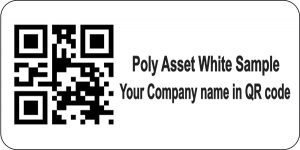
Labels can carry your logo, custom text and serialized barcode numbering. Layout proofs are emailed for approval before production, and physical samples can be mailed where the schedule allows.
Ordering
Size, quantity and numbering are configured above. For a facility-wide rollout, send us the asset count, the surfaces involved and the environment, and we will come back with a recommendation.
Request samples before committing to a full run — particularly if the tags are going onto textured plastics, powder-coated surfaces or anything exposed to weather.
Additional information
| Weight | N/A |
|---|---|
| Quantity | 250, 500, 1000, 2000, 3000, 5000 |
| Label Size | 1 x 2, 3/4 x 1-7/8, 5/8 x 1-3/8, 1/2 x 1 |
| Numbering | Human Readable Numbering BELOW Barcode, Human Readable Numbering ABOVE Barcode, Barcode ONLY (no numbering), Numbering ONLY (no barcode), None (no barcode, no numbering |